
🔥 Fireplace Planning Checklist: What to Decide Before Framing (So You Don’t Rework It Later)
A practical planning guide for homeowners and builders who want the fireplace to feel intentional—not compromised.

Why Fireplace Decisions Should Happen Early
Fireplaces are often treated like finish selections—something to “get to later” once framing and layouts are already in place.
Historically, that would have been unthinkable.
For centuries, homes were quite literally built around the fireplace. The hearth was the structural and spatial anchor of the home. Rooms oriented to it. Daily life gathered around it. Everything else followed its placement.
While modern homes no longer rely on the fireplace for survival, the principle still holds: when the fireplace is planned early, the entire home functions better around it.
When it’s planned late, the result is often the opposite—costly change orders, compromised layouts, awkward venting, undersized fireplaces, and TV walls that never quite feel right.
That’s why this checklist exists: to help homeowners and builders make the fireplace an early planning decision—before framing locks in the opportunity to get it right.
When Homes Were Built Around the Fireplace
In traditional architecture, the fireplace wasn’t an accessory—it was the organizing element.
Walls, circulation paths, and room proportions were all designed with the hearth in mind. It dictated how people moved through the space and where they naturally gathered.
Today’s homes may have more flexibility, but they still benefit from the same thinking. A fireplace that’s planned early integrates naturally into the room. One that’s planned late forces the room to adapt—often through compromises that are difficult to undo.
This checklist helps bring that early-planning mindset back into modern builds.
1) Placement & Room Layout
Before talking about materials or finishes, decide where the fireplace belongs in the room.
Key questions to answer:
Is the fireplace the primary focal point or a secondary feature?
Where do people naturally enter the room?
What does the main seating face?
Will the fireplace be visible from adjacent spaces?
Common placement options:
Centered on a main wall
Corner placement to preserve windows or circulation
Two-sided / see-through to connect spaces
Outdoor placement tied to entertaining areas
Planning tip:
Always think about sightlines first. A fireplace that looks great head-on but awkward from the kitchen or entry often feels “off” once the home is lived in.
2) Furniture Plan & TV Placement
Fireplace planning should never happen without a furniture conversation.
Confirm early:
Will a TV be on the same wall as the fireplace?
If so, will it be above, adjacent, or on a separate wall?
Where will the main seating land?
What viewing height makes sense for daily use?
Fireplaces and TVs compete for attention when not planned together. Early decisions here prevent compromises later—especially around mounting height, wall balance, and proportions.
3) Sizing & Scale
One of the most common regrets homeowners have is a fireplace that feels too small once the room is finished.
Consider scale in relation to:
Ceiling height
Wall width
Overall room size
Furniture mass
A fireplace that looks fine on paper can feel undersized in a tall great room—or overwhelming in a smaller space—if scale isn’t addressed early.
Rule of thumb:
The fireplace should visually “hold its own” against the wall and furniture, not disappear into it.
4) Venting & Clearances (High-Level)
You don’t need to overspec the system publicly—but the team does need alignment early.
Items that should be confirmed before framing:
Venting direction and path
Chase or enclosure requirements
Minimum clearances to framing and finishes
Whether the design allows flexibility later
These decisions affect wall depth, framing layout, and finish thickness—even if the exact unit model is finalized later.
5) Finish Selections That Affect Framing
Fireplace finishes aren’t just cosmetic—they influence structure and layout.
Decisions to flag early:
Surround material thickness (brick, stone, plaster, tile)
Hearth height and depth
Mantel depth and mounting height
Built-ins or shelving flanking the fireplace
If these elements aren’t accounted for early, the result is often:
Shallow mantels
Awkward transitions
Crowded fireplace walls
Missed opportunities for full-height or statement designs
6) Utility Planning (General, Not Technical)
Even at a high level, utilities need to be discussed early.
Confirm early:
Gas availability (if applicable)
Electrical needs (outlets, blowers, lighting)
Switch locations and control preferences
Ignition or control access considerations
These don’t need final specs—but they do need placeholder planning so framing and rough-ins support the design.
7) Bring This Checklist to Your Selection Meeting
Whether you’re a homeowner or builder, having these answers early changes the entire process.
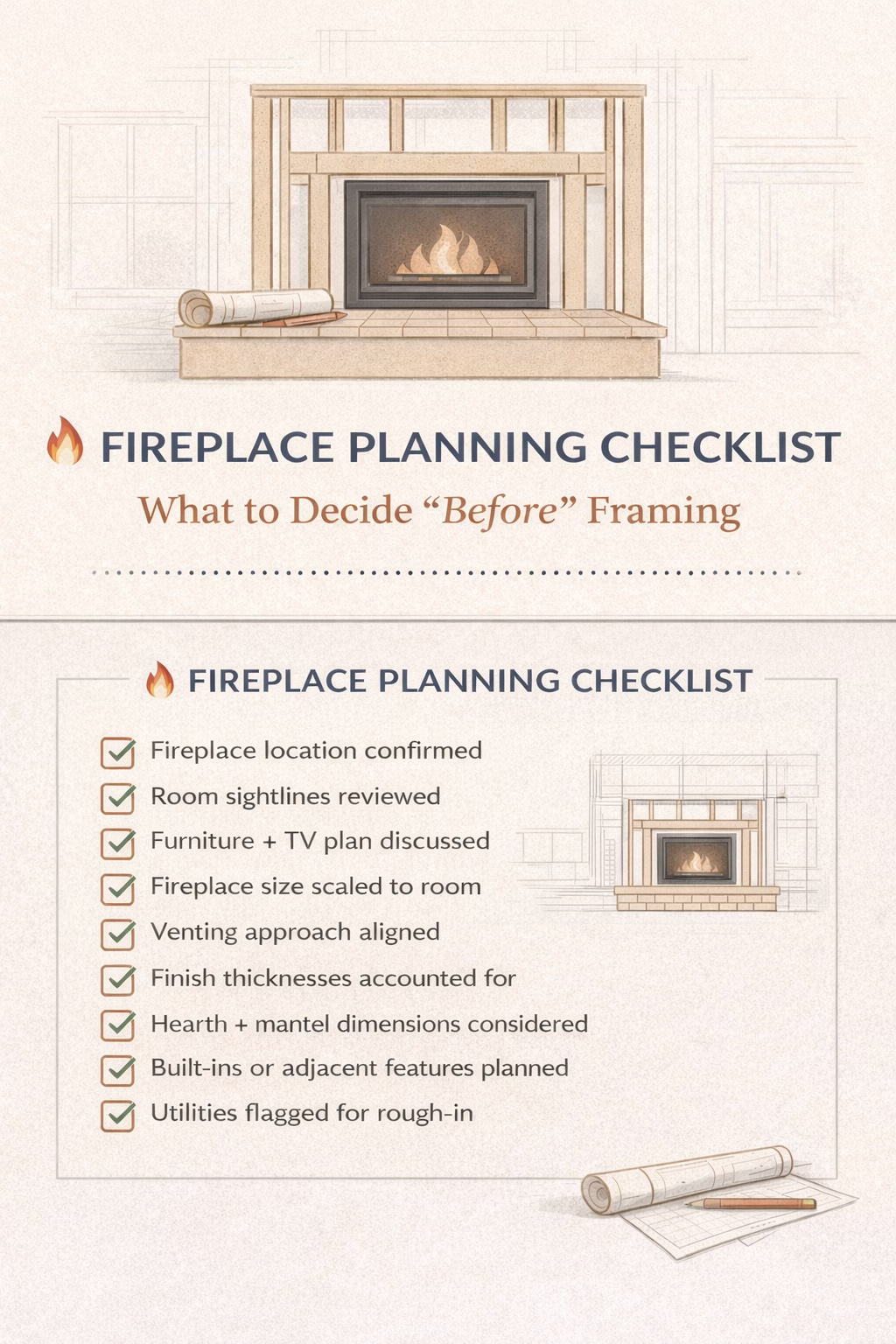
Fireplace Planning Checklist:
☐ Fireplace location confirmed
☐ Room sightlines reviewed
☐ Furniture + TV plan discussed
☐ Fireplace size scaled to room
☐ Venting approach aligned
☐ Finish thicknesses accounted for
☐ Hearth + mantel dimensions considered
☐ Built-ins or adjacent features planned
☐ Utilities flagged for rough-in
🔥 Bringing It All Together
While homes may no longer rely on the fireplace the way they once did, the best-designed spaces still treat it as a central planning element—just as they always have.
The best fireplaces don’t feel “added later.” They feel like they were always meant to be there.
That almost always comes down to early planning—before framing, before rough-ins, and before finishes lock you into compromises.
At Clay Structures, we help builders and homeowners think through fireplace decisions early, so the final result feels intentional, balanced, and built right the first time.
📩 Ready to Plan It Right?
Have a timeline or inspiration photo already in mind?
Share your timeline and inspiration photos—we’ll help you get the fireplace plan right early.
👉 Subscribe to get practical planning guidance delivered straight to your inbox.